Ad Spend Oversight
What I'm building in the space between "I have expertise" and "people will pay for it." The mechanism. The model. The proof it works.

What Happens When You Get Too Deep
After a decade navigating measurement from every angle - Google measurement lead, Amazon research scientist, TikTok product lead, now X technical advisor and fractional consultant - I developed what I privately call the Unified Field Theory of Measurement.
It just means: I can intuitively answer almost any measurement question for any company. Any size, any channel mix, any industry.
Here’s what I learned trying to sell that expertise:
Nobody wants it.
Not because it’s not valuable. Because selling expertise is not a math problem. It’s a human judgment problem.
Measurement decisions are driven by personal beliefs formed from whatever worked once before. If a CMO believes in a channel, they’ll find a metric to justify it. If a CEO doesn’t trust brand spend, no amount of data changes that. If an agency gets paid on media spend, guess what they’ll recommend.
We’re not fighting bad analytics. We’re fighting the Principal-Agent Problem: the people spending the money are rarely incentivized to find the truth.
This is why measurement SaaS companies struggle to close deals. Why consulting takes 6-12 months. Why BCG’s “maturity models” gather dust in Google Drive.
They’re all solving the wrong problem.
The problem isn’t technical. It’s coordination and alignment.
The Language Shift
I’ve stopped using “incrementality” in client meetings.
It’s a marketing science bubble term. I know the math - causal inference, difference-in-differences, the whole toolkit. But math doesn’t win coordination games.
So I simplified. I now call this Ad Spend Oversight.
No jargon shield. No credential flexing. Just: someone needs to check if this money is actually working.
The Incentive Gap: Almost every player in the ad ecosystem is paid to make advertisers spend more.
The Oversight Solution: You don’t need another growth hacker promising 10x ROAS. You need an auditor. Someone to verify if dashboard “success” matches actual money in your bank account.
This reframe changes everything. Suddenly CFOs lean in. CEOs get it. Even marketing teams stop defending their dashboards and start asking better questions.
Because the word “oversight” carries weight. It implies: someone’s watching. Someone’s checking. Someone gives a shit about the truth.
The Map That Didn’t Exist
After 18 months working with companies from $300K to $60M in ad spend - I started seeing a pattern.
Businesses don’t progress through measurement maturity randomly. There’s a predictable journey. But nobody mapped it.
The Measurement Mastery Roadmap:
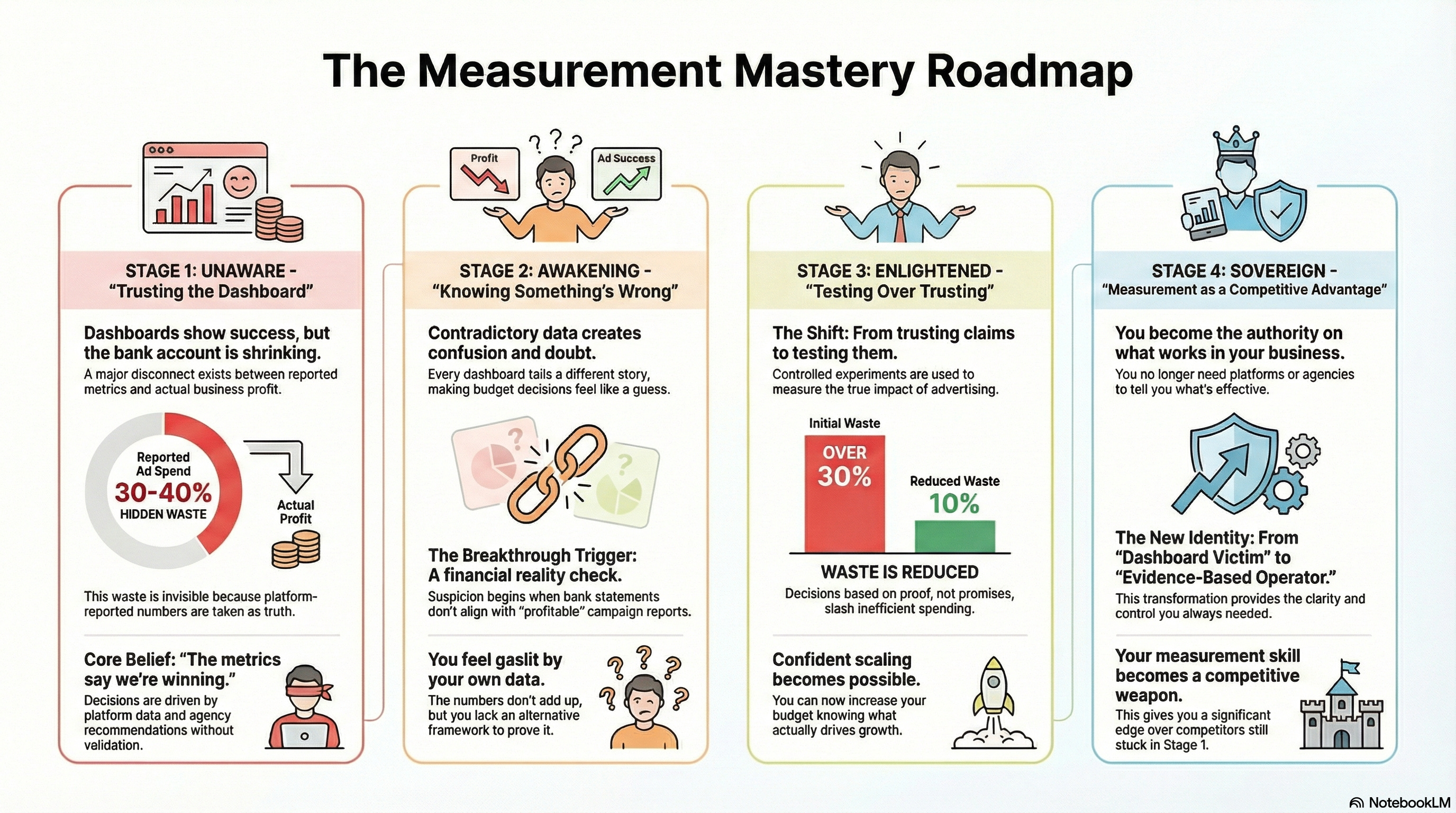
Stage 1: Unaware (”Trusting the Dashboard”)
Dashboards show success. Bank account says otherwise. But you don’t see the disconnect yet because everyone’s nodding along in meetings.
Stage 2: Awakening (”Something’s Wrong”)
You feel gaslit by your own data. Reports don’t match financial reality. But you don’t know what to do about it because testing seems expensive and everyone has an opinion but no one has answers.
Stage 3: Enlightened (”Testing Over Trusting”)
You run controlled experiments. You slash the waste. You find - almost always - that 30-40% of your budget was performative theater. Not all channels. Just certain pockets where attribution deviated far from reality.
Stage 4: Sovereign (”Measurement as Moat”)
You’re the authority on your own business. Platforms don’t tell you what works—you tell them. Measurement isn’t a cost center. It’s your competitive advantage.
The brutal truth: Most businesses waste years stuck between Stage 2 and Stage 3.
Not because they lack resources. Because nobody had a progression roadmap.
The Problem with High-Ticket
I offer two services for companies ready to move fast:
Fractional Marketing Scientist
Marketing ROI Turnaround
Both are right for the right companies. Both take months to close.
Most businesses waste millions while “getting buy-in.” While “considering options.” While waiting for the perfect moment that never comes.
I needed a different path. Not as a stepping stone to high-ticket. As a coordination container for the 80% of businesses who know something’s wrong but aren’t ready to bet $15K on a stranger.
So I built it.
What’s Inside
I soft launched Ad Spend Oversight on Skool.com a week ago.
This is not a scaled-down version of consulting. It’s a different model entirely.
We start with an onboarding call.
Not a sales call. An actual strategic session. We map where you are (Stage 1-3), what you’re trying to achieve in the next 2-3 months, and what roadblocks you’re hitting. This becomes your custom progression plan.
Then you get access to everything:
DM access to me for questions (I check daily)
Weekly 1:1 calls to tackle your specific challenges
Weekly framework walkthrough calls (I teach one concept, we Q&A it)
Group calls where we workshop real problems (yours or others’)
The framework library (more on this below)
But here’s what makes it different:
I’m way more direct inside the community. On LinkedIn, I have to be diplomatic. But inside I call out exploitative practices by name. I expose bad actors’ tricks. I show you the non-obvious ways advertisers unknowingly waste money—not because they’re bad at their jobs, but because the game is rigged.
I’ve also built a library of playbooks for every major platform. Simple, practical steps to eliminate waste from day one. Not theory. The exact checks I run for clients.
The Culture
Here’s what I’m really building: a no-judgment space where people can finally stop performing.
I’ve sat in enough meetings to know the game. Everyone pretends they know more than they do. CMOs nod along to data science presentations they don’t understand. Founders fake confidence about their measurement stack. Teams defend channels because admitting confusion feels like weakness.
This stops the learning.
The best transformations I’ve witnessed happen when people drop the act. When someone says “I don’t actually understand why we’re trusting this dashboard” or “our attribution model might be completely wrong.”
Inside Ad Spend Oversight, you can say that.
What we’re cultivating:
A space where confusions are welcomed, not judged. Where “I don’t know” is the starting point for real learning, not a career liability. Where we share oversight wins in human speak - not sanitized case studies, but the actual messy stories.
What we celebrate:
Not just saved budgets (though we track those). But progression. Someone moving from Stage 2 to Stage 3. A team finally understanding why their attribution was broken. A founder gaining the language to push back on their agency.
Because measurement maturity isn’t a number. It’s the ability to make decisions based on evidence instead of who speaks loudest in the meeting.
The Framework Library
I spent 2 years building the Unified Field Theory of Measurement. I could teach it in a single workshop.
But that would be useless.
Because expertise doesn’t transfer through information dumps. It transfers through progressively building mental models.
So I sliced it into digestible pieces. Each one is a framework or playbook that solves one specific problem:
Why attribution breaks (History of Measurement)
Why everyone’s confused (3 Layers of Reality Model)
How to audit for hidden waste
How to talk to your CFO about brand spend
What incrementality actually means (without the jargon)
I add new frameworks weekly. We review them together in calls. You ask questions. We workshop your specific situation. The concepts become yours, not mine.
This is R&D happening in real-time. You’re not buying a finished course. You’re getting direct access while I’m still hands-on, building the library with you.
Join Ad Spend Oversight: https://www.skool.com/ad-spend-oversight/about