Everyone's Playing the Coordination Game. The Market Is Paying for Causation.
Why specialists are winning, and what happened when I tested this with everything on the line.

I woke up one Tuesday in March 2024 and couldn’t do it anymore.
Not “didn’t want to.” Couldn’t.
My body had decided before my mind caught up. I lay there staring at the ceiling, feeling something I’d never felt before. Not exhaustion. Revolt.
I turned to my wife. “I think I need to quit.”
The words surprised both of us. I’d been at TikTok for almost a year, Amazon before that and Google before that. On paper, this looked like progress. Diversity Visa lottery at 34. Started from almost nothing. No US degree. Each performance review and job change felt like proof I could make it here.
But something had broken. Slowly, then all at once.
The Slow Burn
The numbness started small.
I thought I’d joined TikTok to implement and adapt causal measurement and incrementality testing. The scientific frameworks for understanding what ads actually cause versus what they merely touch. That’s what I understood the role to be.
Instead, I found myself doing project management. Product marketing. Stakeholder alignment coordination. Scope shifts happen. Teams change. You adapt.
So I forced myself. Every morning, a little harder. The resistance building like scar tissue.
I remember sitting in a project status update, nodding along, and realizing I hadn’t heard a word for five minutes. I was there. But I wasn’t there.
Late evenings, I’d watch The Sopranos. Not because I loved it. Because I needed to escape the loop I was stuck in. Force yourself, feel numb, force harder, feel more numb.
Artificial deadlines appeared. Milestones that felt disconnected from actual outcomes. That specific type of pressure that comes from urgency designed by people several layers removed from the technical reality underneath.
Until that Tuesday when something in me said: No more.
The Remit
Here’s what made it unbearable.
I started joining client meetings. Advising clients. Supporting projects where my measurement expertise could actually help. The work I was good at. Advertisers struggling to understand incrementality.
I tried to evangelize it internally too. Talked to different leaders up the management chain. Explained why this mattered. How we could help clients better.
I didn’t succeed at that.
Looking back, I was trying to find ways to connect my skills to value creation. Maybe I didn’t try hard enough. Maybe I was pushing against organizational gravity. Either way, the message became clear: this isn’t what you’re here to do.
The warnings came. “This isn’t your remit. Focus on product marketing and project management.”
I kept doing it anyway for a while. Eventually I stopped trying. That’s when the real numbness set in.
The system wasn’t broken. It was working exactly as designed. Just optimizing for something different than I was.

Pattern Recognition
During my break after that Tuesday, I started seeing patterns I’d been too close to notice.
Every energizing moment in my career had the same structure: complex problem that needed solving, I could apply deep expertise, I could trace my effort directly to impact. That line from effort to outcome. That’s what made work feel like work worth doing.
Every draining moment had a different structure: managing perceptions, navigating politics, optimizing for metrics that didn’t measure what actually mattered.
At Google, I’d fallen in love with measurement because we were helping advertisers prove the value of their media beyond last-click attribution. Run an incrementality test. Show that brand campaigns were driving lift the dashboards couldn’t see. Watch an advertiser’s entire framework shift. That hit of knowing this insight changed how they’d allocate millions.
The higher I climbed, the further I got from those moments.
Here’s what I realized about myself: I wasn’t good at the corporate game. I’d tried. I always focused on helping others, uplifting teammates, even when it cost me credit in performance reviews. I tried to adapt to the system. Tried to learn the unspoken rules.
I didn’t succeed overall.
Some people are natural at it. The positioning. The visibility management. The careful credit claiming. That’s not judgment. Just not me.
My body was trying to tell me something I wasn’t ready to hear yet. That knot in my stomach every Sunday evening.
The Specialist Trap
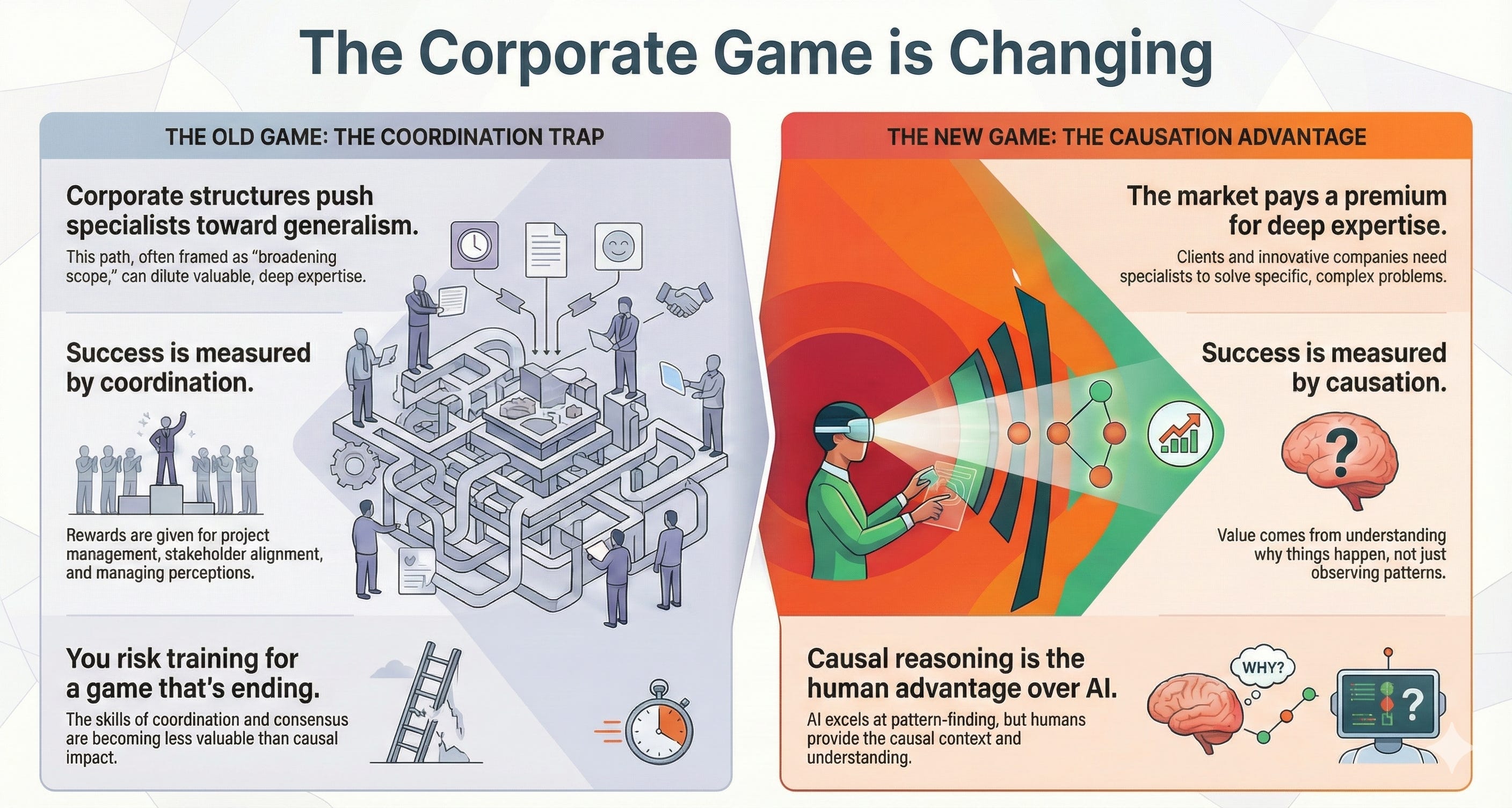
Corporate progression has a pattern. It pushes specialists toward generalism.
You’re “too narrow.” Need to “broaden your scope.” Be “well-rounded.” A “team player.”
I watched brilliant specialists get feedback to “think more strategically.” Stop being so good at that specific thing. Learn to speak PowerPoint. Wear more hats.
Corporate calls it “broadening your scope.” I call it productive mediocrity.
Then I started consulting on the side. Early fractional work. And clients wanted something completely different. They wanted depth. Specific expertise applied to specific problems. They’d pay premium rates for someone who actually understood causal inference.
The trap became visible. Corporate was training me for the thing becoming obsolete while calling it growth.
What I Was Seeing
Let me be clear about something. I met incredibly talented people at every company I worked at. Google, Amazon, TikTok. Smart, capable, driven people trying to do good work within the systems they inherited.
We’re all playing the game we’ve been given. The rules were written before most of us showed up.
But I was observing something across all these environments. Advertisers confused about what was actually working. Platforms optimizing for their own metrics. Agency teams caught in the middle. Everyone had charts. Nobody had clarity on causality.
And I was seeing the landscape shift. Fractional roles emerging. Consulting taking different shapes. People with deep expertise building practices outside traditional structures. New models, new mechanisms.
The old binary of “full-time employee or unemployed” was breaking down. Something else was forming.
The Game Is Changing
Maybe you’re reading this during a break between meetings. Checking your phone because sitting through another stakeholder alignment feels like slow death. You’re not burned out. You’re just bored solving problems that don’t matter.
Here’s what I think is happening. Not enough people are talking about it.
We’re shifting from an economy that rewards pattern-finding to one that rewards causal thinking.
Pattern-finding is seeing what happened. Observing correlations. Making decisions based on what appears to be true.
Causal thinking is understanding why it happened. What mechanisms are actually at work. What would happen if you changed one variable.
Consider this: A company notices their best-performing salespeople all went to top-tier universities. They start hiring exclusively from those schools. Performance doesn’t improve. Turns out the correlation existed because top performers also happened to come from wealthy networks, which gave them warm leads. The university didn’t cause the performance. The network did.
Proximity to objective reality determines who wins.
In business, you’re making bets. Launch this feature. Hire this person. Allocate budget here. Every bet is a hypothesis about cause and effect. The closer your hypothesis matches actual causality, real-world mechanisms rather than surface patterns, the higher your success rate.
Companies that optimize for appearances will lose to companies that optimize for reality.
Companies are starting to intuit this. They’re auditing their value creation processes. Trying to understand which activities actually drive outcomes. Which employees contribute causally versus just touch successful projects.
Not all are using the right causal frameworks though. Some are making reckless, erratic decisions driven by shareholder pressure or free cash flow concerns. Cutting what looks expensive without understanding what it actually causes. Measuring with the same correlation-based tools that created the confusion in the first place.
The companies that figure this out will dominate. Because they’ll be making decisions based on how things actually work, not how things appear to work.
AI accelerates this shift. It’s exceptional at pattern-finding. It can scan millions of data points instantly. But it can’t tell you why the pattern exists. It can’t separate signal from artifact. It assumes the future will look like the past.
Only humans can do causal reasoning. We bring context. We understand mechanisms. We know which correlations are mirages and which point to something real.
Specialists beat generalists because depth is what enables causal thinking. You need thousands of hours in a domain to see past surface patterns. To know which variables confound which. To build intuition that’s actually rapid causal reasoning.
Corporate structures are still optimizing for the old game. Pushing depth toward breadth. Rewarding political skill over the ability to understand how things actually work.
The real cost: The next five years spent building expertise in coordination and consensus when the market will be paying for depth and decisiveness.
A lot of people are training for a game that’s ending.
The Immigrant’s Calculation
I’d won a lottery, literally, to come here at 34. Spent two years in survival jobs. Twelve-hour shifts where I’d catch myself wondering if the diploma from back home meant anything here. If I’d made a catastrophic mistake at 34. Language barriers. The constant anxiety layered on top of exhaustion.
Landing that contractor job at Google felt like proof the bet had paid off. Converting to full-time meant I could actually stay. Every performance review, every job change after: don’t mess this up. People like you don’t get second chances.
Sunday evenings, that specific dread about Monday morning: “You started from zero. You have a family now. A daughter. How can you walk away from stability?”
But another voice, quieter at first: “What is she learning by watching you? That you endure misery for a paycheck? That you become someone you don’t recognize because it’s safe?”
The question changed: Not “Can I afford to leave?” but “Can I afford to stay?”
Because here’s what became clear: I’d already done the hardest reset once. Started from zero in a new country with nothing but determination. I knew how to do it.
This time I had what I didn’t have at 34: a decade of deep expertise in a valuable domain. Skills that couldn’t be taken away. A network built on actually helping people solve real problems.
The calculation shifted.
Data, Not Flaw
Away from the daily grind, pattern recognition kicked in.
I’m not corporate material. Data, not flaw.
Some people genuinely thrive in large organizational structures. They love consensus-building, stakeholder management, the intricate dance of moving big ships slowly. They’re not performing. That’s who they are.
I was performing. And the performance was killing me.
What hit me hardest: Even if I found a “perfect” company, I’d still be playing corporate games. Still optimizing for manager perception instead of actual impact. Still disconnected from the direct line between effort and outcome.
That line matters. When you can see your work creating value in real time, you learn faster. Correct faster. Build intuition that’s grounded in reality, not politics.
Misalignment gives you information.
The Experiment
I didn’t have a perfect plan leaving TikTok in March 2024.
I had a testable hypothesis.
Could the measurement expertise I’d built inside BigTech serve the advertisers who needed it most?
Could I build a practice that aligned making impact with making a living?
Could I prove that deep specialization was more valuable outside corporate walls than inside them?
I didn’t know. But I’d spent enough years running experiments to understand: the only way to find out is run the experiment.
The alternative was clear: keep performing, keep advancing, keep optimizing for someone else’s metrics, keep becoming someone I didn’t recognize.
My daughter is watching. What am I teaching her about agency? About facing uncomfortable truth? About what to do when the game you’re winning isn’t the game you want to play?
Progress starts when you stop negotiating with reality.
That Tuesday, my subconscious figured it out first. Took me a few more months to catch up.
What Came Next
Leaving was the easy part.
What came next was harder than anything I’d done in BigTech.
I decided to do something unconventional. I wrote a LinkedIn post laying out my vision and journey openly. No corporate polish. No safe positioning. Just the truth about what I’d observed and what I was building.
The response surprised me. Within days, the post got 33,000 impressions. More than 800 profile views. My inbox filled with messages from people who’d been feeling the same misalignment. Meeting requests from potential partners. Within weeks, two strategic partnerships emerged.
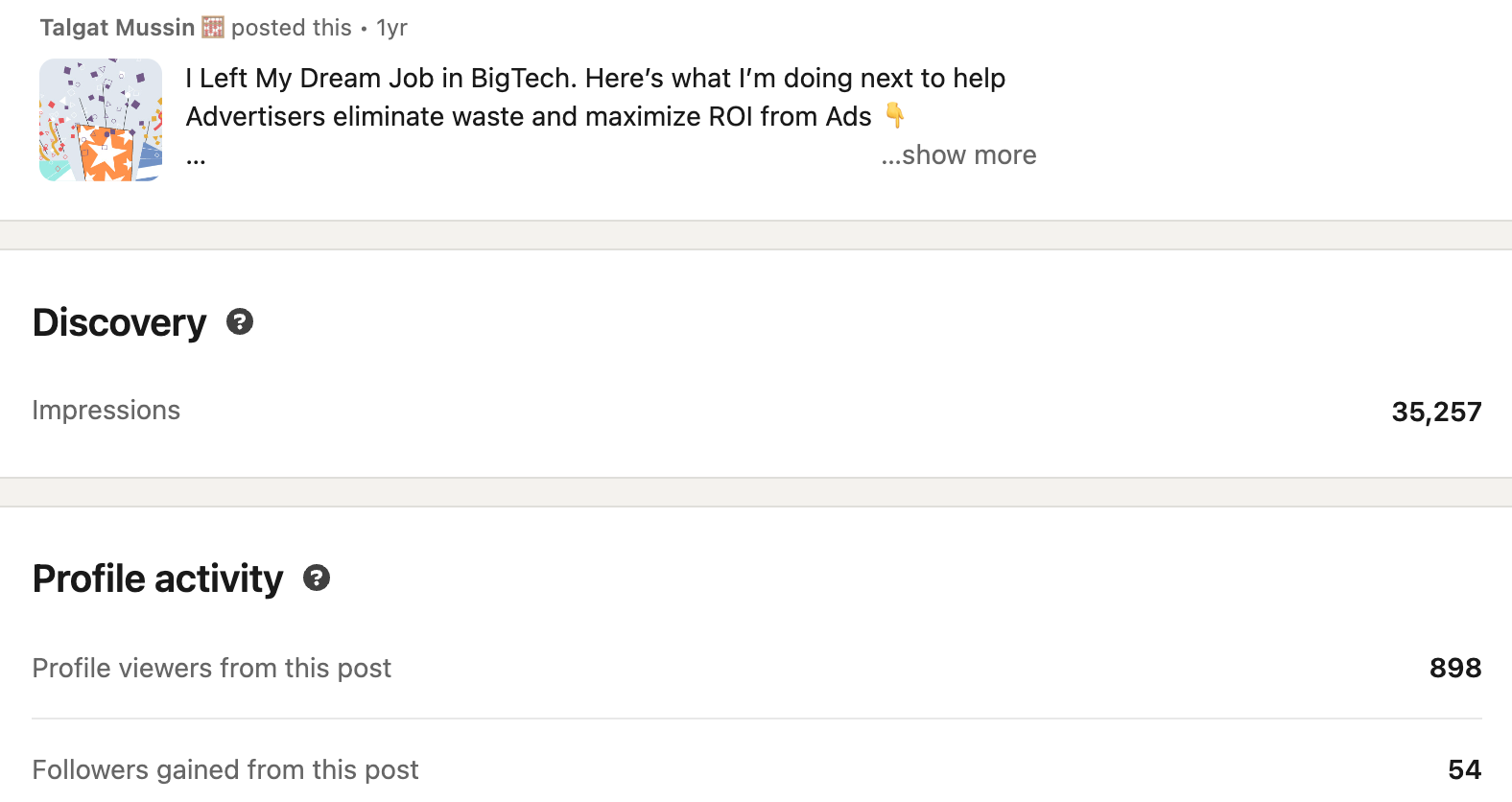
The signal was clear: I wasn’t alone in seeing this shift. Others were feeling it too.
But here’s what mattered more than the numbers. The conversations that followed revealed something bigger. People weren’t just interested in my personal journey. They were hungry for a different model. A way to do meaningful work without the performance theater. A path to self-actualization through work that actually matters.
What started as my escape from corporate turned into something else. A movement forming around a simple idea: work should align who you are with what you create. Your expertise should compound, not dilute. The line from effort to impact should be visible, not obscured by organizational layers.
What I’m building goes beyond measurement consulting. A collective of practitioners who’ve chosen depth over breadth, reality over perception, impact over optics.
Part 1 of 3.
Part 2 drops in a couple days: Unlearning corporate thinking. The expert curse. Building with practitioners. Decisions from feedback, not fear.
Part 3: The pivot. The ICP. The offer. The blueprint.
You’re still reading because you’re feeling something. That misfit feeling?
Not weakness. Detection system. Early warning the game is changing.
Most people will ignore it. Keep training for coordination while the market pays for causation.
A collective is forming. Practitioners choosing depth over breadth. Reality over perception. Impact over optics.
If you feel it, you’re already part of it.
- Talgat