The Unlearning
Expert curse, corporate conditioning, and decisions from feedback instead of fear (Part 2 of 3)

The first Monday after I left TikTok, I made coffee and sat at my desk.
No Slack (Lark). No calendar invites. No one telling me what mattered today.
I opened my laptop. Stared at the screen. Closed it.
Opened it again. Stared.
I’d spent a decade being told what success looked like. Hit these OKRs. Align with these stakeholders. Ship by this date. The system was exhausting, but it was a system. It gave shape to the days.
Now the days had no shape.
I checked my bank account. Did the math. Divided savings by monthly burn. Counted the months until I’d have to go back, pretending this was a “sabbatical.”
The number was smaller than I wanted.
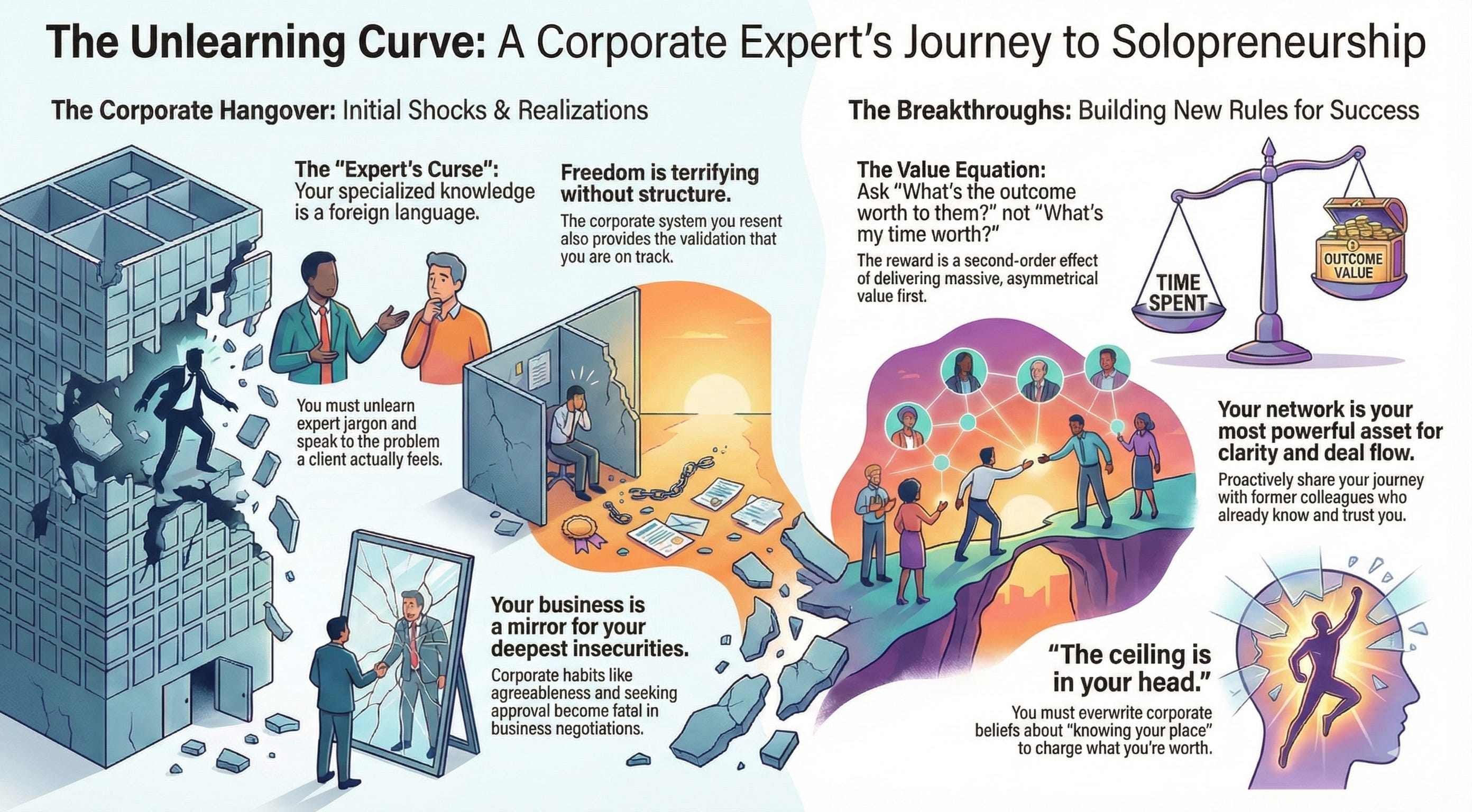
That first week taught me something about freedom. It’s terrifying when you don’t know what to do with it. The structure I’d resented was also the structure that told me I was okay. Without it, I had to answer a question I’d been avoiding.
What do I actually want to build?
I didn’t know. And not knowing felt like drowning in slow motion.
The Humiliation
My first real client call was supposed to be easy.
A business owner. Significant ad spend. Confused about measurement. Exactly the problem I’d spent years solving.
I showed up confident. Started explaining incrementality and measurement frameworks. The statistical rigor behind geo experiments. Why incrementality experiments reveal what attribution dashboards hide.
Ten minutes in, he interrupted.
“So... can you just tell me if my Meta ads are working?”
Silence.
I’d been speaking a language he didn’t understand. Worse, I didn’t know how to translate. I stumbled through an answer. The call ended politely. He never followed up.
That night I sat with it. I’d assumed my expertise would speak for itself. That the value was obvious. That people would recognize what I knew and pay for it.
Wrong.
When you’ve spent years inside a bubble of specialists, you lose calibration. What feels basic to you is actually rare. But you can’t see it. And you can’t explain it to someone outside the bubble.
Once I recognized this pattern, I started seeing it everywhere. Especially on LinkedIn. Experts talking past the people who need them most.
I started paying attention differently. Every conversation became data. Which explanations landed? Which got blank stares? What metaphors worked?
The pattern was clear. I had to unlearn an expert language and relearn human language. Speak to the problem they felt, not the methodology I loved.
That guy didn’t care about incrementality. He cared about whether he was wasting money. Same problem. Different frame.
That’s why I put extra effort now into simplifying concepts and language. Not dumbing down. Translating. There’s a difference.
The translation gap nearly killed my business before it started.
The Breakthrough
Three weeks in. 2 AM. I was watching a Myron Golden video.
I’d been consuming content constantly. Courses, podcasts, YouTube rabbit holes. Most of it blurred together. Generic advice about finding your niche and building your personal brand. Content for people still searching for their expertise.
I already had expertise. I needed something else.
I was half-asleep, ready to close the laptop, when Myron said something that made me sit up.
“The reward is always a second-order effect of the value you create.”
I played it again.
Second-order effect. The money comes after. And there has to be a gap. An arbitrage. You deliver massive value. The payment is less than what that value is worth to them.
If the equation is even, something’s wrong. If you ask for payment before delivering overwhelming value, it feels like fraud. The sequence matters. The asymmetry matters.
I started seeing this everywhere. Hormozi, Priesley, Brunson and many others. Different language, same principle.
This changed how I thought about pricing. I’d been asking “what’s my time worth?” Wrong question. The right question is what’s the outcome worth to them. And how do I deliver so much that my fee feels like a bargain?
The Moment It Clicked
Six months in. I’m on a call with an enterprise client. Big brand. Real budget.
Forty minutes of good conversation. They clearly needed help with measurement. I clearly could help. Now came the part I dreaded.
“What’s your rate?”
I’d done the research. I knew what MBB consultants charge. The number I’d written down was in that range. But when the moment came, my throat tightened.
Who was I to charge that? Six months ago I was an employee. Now I’m quoting this level of rate.
The voice in my head started up. You’re not a real consultant. You’re a guy who quit his job. They’re going to laugh. Quote something lower. Be safe.
I said the number anyway. No discount. No apology.
Silence. Three seconds that felt like thirty.
I was mentally preparing my walkback when they said, “That works. Let’s do it.”
I muted myself so they wouldn’t hear me exhale.
The ceiling is in your head. The beliefs you develop in corporate don’t disappear when you leave. Stay in your lane. Know your place. Don’t overreach. They run in the background.
You have to overwrite them. What I started calling “self-brainwashing on what’s possible.”
Every time I caught myself thinking small, I forced a bigger thought. Not a delusion. Permission. Permission to charge what the value was worth. Permission to believe I could build something real.
The Writing Revelation
Most of our struggle happens inside our own heads.
The expert curse. The loneliness. The imposter voice. All of it happens in isolation. Ideas never tested. Fears never named and confronted.
A few weeks after leaving, I made a decision that changed everything.
The most valuable thing from the companies I worked for wasn’t technical knowledge. It was the people. Colleagues who’d seen me solve hard problems. Peers who trusted my judgment.
That network was an asset. But only if I maintained it.
I know what happens when you don’t. Connections fade. A year passes. Suddenly you’re a stranger asking for favors instead of a friend sharing updates.
So I did something tedious.
Two weeks. LinkedIn messages to almost every person I’d worked closely with. Over a hundred messages. “I jumped ship and went solo. Would love to keep you posted. Drop me your personal email?”
Most responded positively. A few ignored. A couple said no thanks. But most wanted to follow along.
I ended up with a list of over 200 people. Not strangers from a landing page. People with shared history who could give honest feedback because they had context.
I started sending updates every few months. Progress. Learnings. What was working. What wasn’t. True behind the scenes and learnings.
Open rates ran 80 to 90%. Warm list, real relationships.
Then something happened.
The replies started turning into opportunities. “I know someone who needs measurement help.” “We’re looking for an advisor with exactly this background.” “Have you thought about partnering on this?”
Almost all my earnings that first year came from that email list. Or one degree removed.
Writing created clarity. It also created deal flow.
Most ideas stay trapped in your head. That’s where the expert curse lives. The loneliness. Deploy your thinking through writing. Start with people who already trust you.
The Mirror
Building a business is harder than becoming a parent.
I have a daughter. I know what it’s like to have your life reorganized around another human’s needs. To confront your own patterns because now they affect someone who depends on you.
Building a business does the same thing, but with a twist.
With a child, life forces the confrontation. You can’t ignore a crying baby.
With a business, you have to force yourself. Every day. No external structure makes you face your avoidance, your fear, your excuses. You can hide. Procrastinate. Tell yourself tomorrow is better.
Early on, I was negotiating with a potential partner. They were pushing on terms that felt unfair. I knew I should push back. I had leverage. They needed my expertise more than I needed their platform.
But the old programming kicked in. Don’t make waves. Be agreeable. Take what you can get.
I folded. Accepted terms I shouldn’t have. Told myself it was strategic.
It wasn’t strategic. It was fear wearing a costume.
That night I sat with it. Why did I fold when I had leverage?
The answer was uncomfortable. I was still seeking approval. Still optimizing for being liked instead of being respected.
Your business becomes a mirror. Every insecurity surfaces. Every boundary issue shows up when you need confidence most.
More people need to talk about this. The silence makes everyone think they’re uniquely broken.
The People Who Made This Possible
I need to pause and say something.
If you’re reading this and we worked together, at a partner firm, on a client project, at a conference/workshop, thank you.
The partners who brought me into client work when I had no track record on my own. The people who invited me to present on stages. The clients who trusted me with real problems and real budgets.
This past year I’ve traveled across the US and internationally for this work. Had dinners that went hours longer than planned. Client onsites where real problems got solved.
None of this happens alone. I’m grateful for every opportunity to collaborate and serve.
The Landscape Nobody Talks About
I want to be honest about what I see out here.
There’s a lot of noise about fractional roles and solopreneurship. People on LinkedIn are painting pictures of freedom and flexibility. Eighteen months into building, I see it differently.
Some fractional work is real. I’ve done it. It can be good. But a lot of people out here are struggling. Building products nobody wants. Chasing positioning frameworks when they should be talking to customers. Burning savings while pretending everything is going great.
The LinkedIn version is rarely the real version. I’ve had private conversations with people whose public posts look like success. Behind the scenes: anxiety, desperation, regret.
I’m not saying this to be dark. I’m saying it because pretending doesn’t help anyone.
Here’s what I actually see. Huge demand for practical guidance. The challenges are the same across the board. How do I translate expertise into something the market pays for? How do I sell without feeling like a fraud? How do I stay sane when the structure disappears?
And the pressure is increasing. Layoffs will continue. AI will replace more roles. The re-orgs aren’t stopping. The people who figure out how to create value independently will be fine. The people waiting for stability to return will wait forever.
The Confusion Tax
Our industry has made measurement impossibly confusing. Not by accident.
Every platform has its own attribution model. Every vendor has its own methodology. Every consultant has their own framework. MMM, MTA, iROAS, POAS. The acronyms multiply. The cognitive load is enormous.
These aren’t separate problems requiring separate solutions. They’re all pieces of the same puzzle. But no one is incentivized to show you the whole picture. Platforms want you dependent on their dashboards. Vendors want you locked into their tools. Fragmentation is profitable.
There’s a deeper asymmetry here that’s been running for over two decades.
Ad Platforms pay top dollar for the best scientific and measurement talent. They hoarded the thinking power. Built sophisticated internal frameworks. Used that knowledge to extract maximum value from advertisers.
Meanwhile, advertisers got squeezed from every direction. No access to that expertise. No map. Just a flood of dashboards, each designed to justify more spend.
Only in the last few years have some advertisers started awakening. Investing in causal measurement. Building internal capabilities. Starting to win.
But most are still lost. Still paying the confusion tax. Still making decisions based on numbers that look precise but mean nothing.
Leaving corporate gave me something I didn’t have before. Headspace. Time to step back and see the whole system.
I’ve spent a year synthesizing everything. What I learned from 9 years across Google, Amazon, TikTok and frontline consulting work. Academic papers. Industry research. All of it is distilled into what I’m calling a Unified Field Theory of Marketing Measurement borrowing from physics, philosophy, mathematics, and military strategy.
That sounds abstract. So I translated it into something practical. Applied a Hero’s Journey narrative arc to make it easy to follow. The working name is the Advertiser’s Hero Journey.
It’s a clean, linear path. Depending on where you start, you see exactly where you are and what comes next. No confusion. No acronym soup. Just the straightest route from confusion to causal clarity.
Think of it as a shortcut. Guided by practitioners who’ve adopted and scaled these systems inside the biggest platforms. Me and several FAANG peers who are joining as partners.
I shared a high-level concept earlier called the Measurement Elevation Atlas. That was the starting point. What I’ve built goes much deeper.
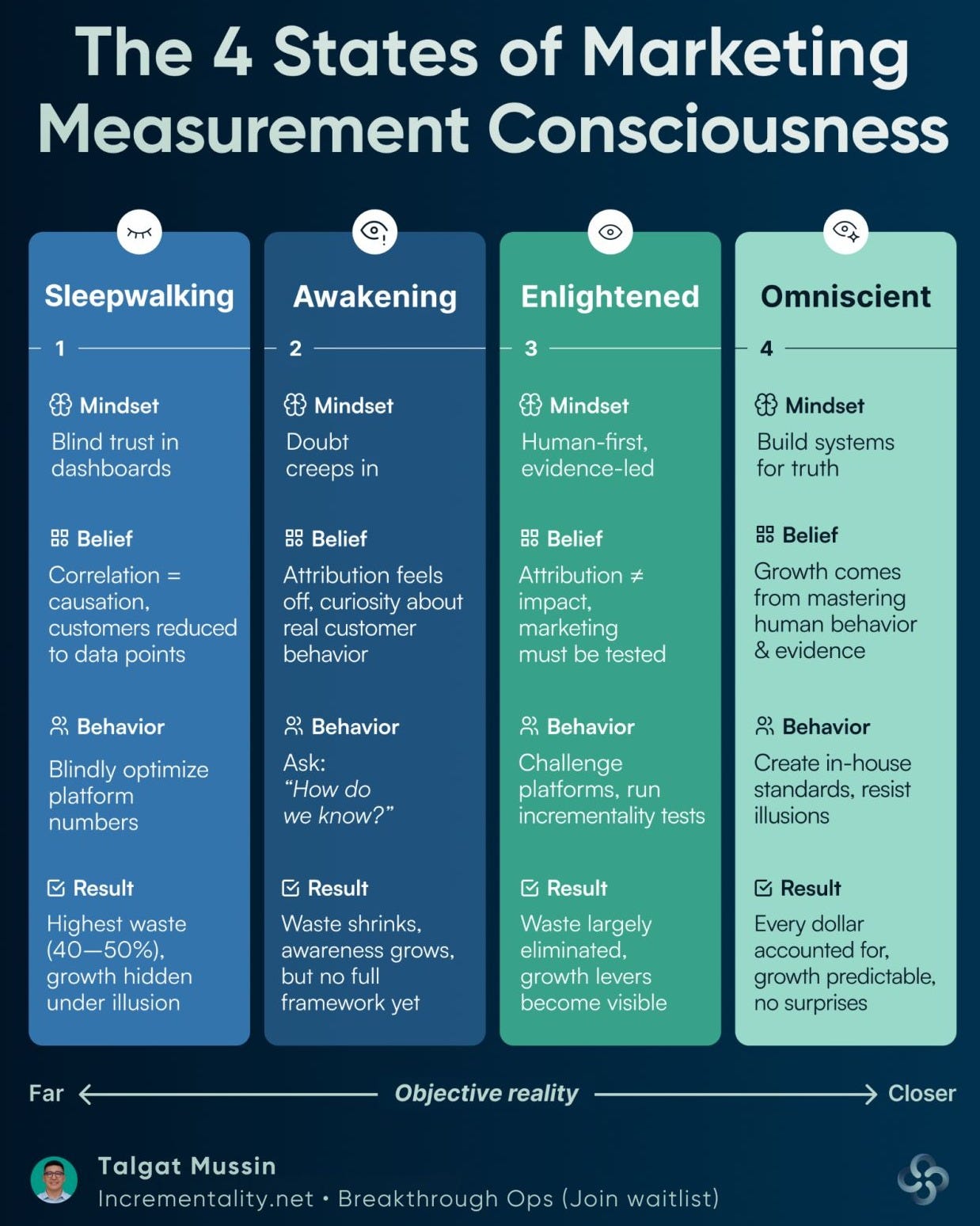
That’s what Essay 3 is about. The offer was built around this. A category that didn’t exist because no one was incentivized to create it.
Until now.
Where I Am Now
A practical update, since I promised real numbers.
In the last few months, my business revenue through consulting, advisory, and various gigs reached the level of my last corporate salary.
That sounds like a win. It is. But context matters.
Taxes hit differently when you’re self-employed. Health insurance for a family costs real money. And my burn rate is higher than it needs to be because I’m investing heavily in parallel projects. The Unified Field Theory. Content production. Videos. Foundation for future growth, not just current income.
If I just wanted to coast as a consultant, I’d be satisfied. Take the clients that come, do good work, pay the bills. But that’s not why I left corporate.
I’ve walked away from a couple of attractive full-time job opportunities this year. Turned down higher-paying gigs that would’ve drained time from what I’m actually building.
The struggle isn’t financial. It’s about balancing everything and pushing through the challenges that come with building something bigger.
Life started testing me. Those job offers weren’t accidents. Comfortable salaries. Good titles. The easy button back to stability.
I said no.
Here’s why. I’ve been through enough cycles to recognize the pattern. Taking the job would be a bandaid. Short-term easy mode. But all the issues would return. The misalignment. The numbness. The slow death of trading years for a paycheck.
I have to go through the pain and transformation. There’s no shortcut to breaking free. No way to self-actualize without the struggle.
Someone said it better than I can:
A salary is a drug they give you when they want you to forget about your dreams.
The stakes are higher now. Vision is clear. That’s a different kind of struggle than not knowing what you’re building. This one I can work with.
I’m not doing this alone. A few FAANG peers have come in as partners and early supporters. People who understand the domain and believe in what we’re building.
What Comes Next
I started the peer email list to stay connected. It worked better than expected.
Now I’m moving that approach here.
Let me be clear about what I’m building on this Substack.
My main business has a narrow, specific focus. A new category and scalable offer for a particular type of client. That’s I will explain in Part 3 (dropping in fews days)
But I want to be useful to everyone navigating this landscape.
The core content here stays free. No paywall on the main insights. I’ll keep sharing what I’m learning about incrementality, causal measurement, and the adtech ecosystem. But also the broader territory I started exploring in The Intuition Moat. Causal thinking. Signal versus noise. The invisible rules that govern truth in business and beyond. Once you see it, you can’t unsee it.
For those who want more access, I’m creating a Founder tier.
Marketing professionals, measurement folks, anyone building expertise into something independent. Behind-the-scenes of building a new category. Practical insights. Light consultation. The roadmap for turning expertise into a real living.
I’m keeping it affordable. Priced so you can expense it through corporate L&D or education budgets. No barrier for people serious about this path.
That’s where I’ll move my peer list. If you want closer access to how this unfolds, subscribe to get notified when I open it.
But first, I need to tell you what changed everything.
Even with frameworks, partnerships, network, revenue, something was still wrong.
I was building for the wrong customer.
Part 3 coming soon.
The pivot. The ICP clarity. The offer that finally fit. The collective forming.
The cliff I stood at that first morning hasn’t disappeared.
But I stopped staring at the void.
I started building the bridge.
— Talgat